
A portable Bluetooth speaker can be the simplest upgrade for a bedroom, workshop, dorm room, or weekend trip. But choosing only by wattage, size, or an impressive-looking product photo often leads to disappointment. A better comparison starts with the sound you prefer, where you will listen, and how the speaker actually behaves on battery power.
1. Judge sound quality before the wattage number
A higher advertised wattage does not guarantee clearer sound or deeper bass. Driver design, cabinet size, digital signal processing, and the manufacturer's tuning all influence the result. A compact speaker may sound balanced at moderate volume but distort when turned up. A large unit may produce more bass yet be inconvenient to carry.
If you can test it, play familiar music with vocals, acoustic instruments, and steady bass. Listen for muddy speech, harsh treble, rattles, and distortion. Keep the volume reasonable; distorted sound at maximum output is not always representative of normal listening. Compare speakers at roughly similar perceived loudness.
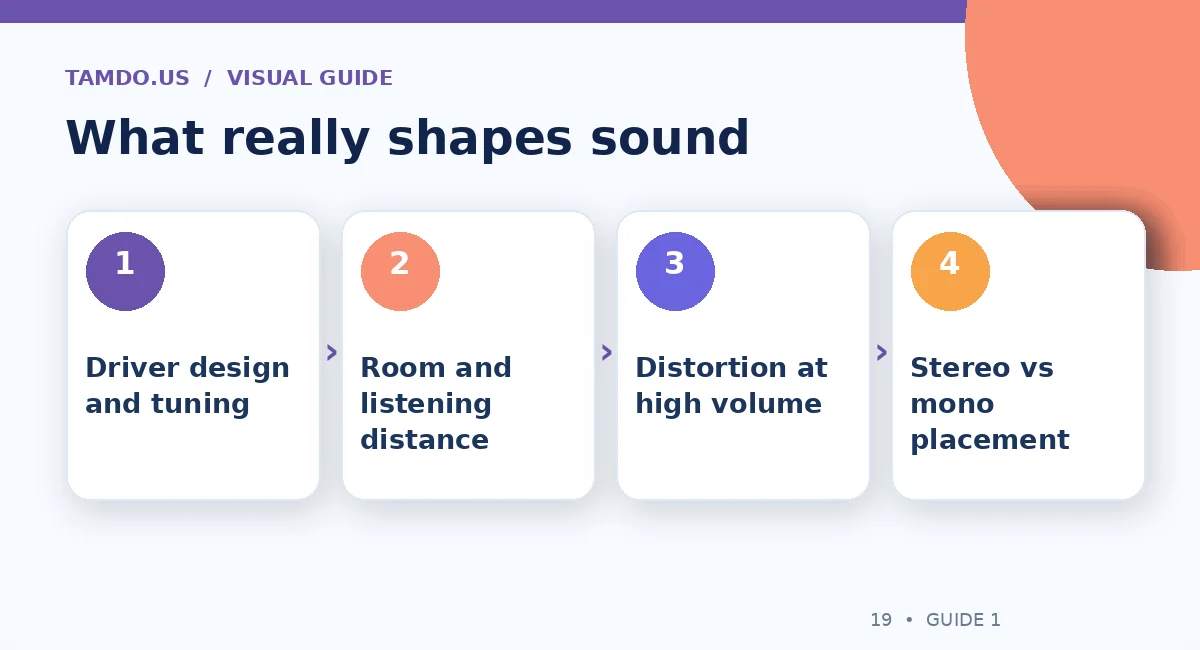
What really shapes sound — original educational illustration created for TamDo.us.
2. Consider how and where you will use it
For a desk or bedroom, clear vocals, simple controls, and reliable low-volume performance may matter most. For outdoor gatherings, output capability, ruggedness, and battery life become more important. Some speakers support stereo pairing or party modes, but those features may require another compatible unit or a particular app.
Portability has trade-offs. A small speaker fits a backpack but has limited physical space for large bass drivers. A large speaker may be more satisfying at a party yet need a handle, a dedicated charger, or more storage space. Match the purchase to real habits rather than an imagined best-case use.
3. Battery ratings are estimates—not promises
Manufacturers usually quote runtime under test conditions. Volume level, bass-heavy music, lights, temperature, and battery age can shorten actual playing time. Used speakers deserve a closer check: confirm that the charging port works, the device holds a charge, and the battery does not abruptly shut down at moderate volume.
Ask how long the speaker plays under typical use, and whether the original charger or cable is included. If the battery is sealed, a failed cell may be expensive to service. A slightly cheaper speaker with unreliable charging is often poor value compared with a healthy unit.
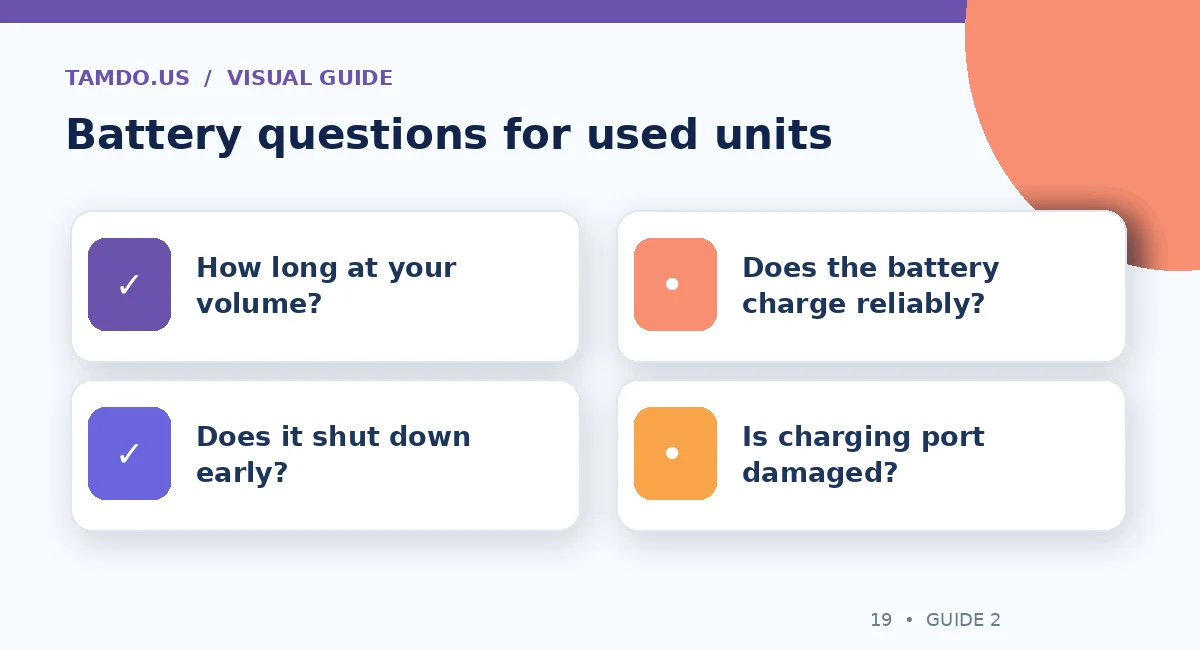
Battery questions for used units — original educational illustration created for TamDo.us.
4. Understand water-resistance ratings
IP ratings describe specific standardized tests for dust and water ingress protection. For example, IPX4 commonly indicates splash resistance in the tested configuration, while IP67 generally indicates dust-tight protection and protection under specified temporary immersion conditions. The “X” means a dust rating was not specified, not that the speaker is necessarily dustproof.
Ratings do not make electronics indestructible. Salt water, soap, damaged seals, impacts, and normal aging can change real-world protection. Keep port covers closed as directed by the manufacturer, and never charge a device while its charging area is wet. For a used speaker, inspect the seals rather than assuming the original IP rating still applies perfectly.
5. Bluetooth versions and codecs: what matters in practice
Bluetooth versions describe technical capabilities, but your experience also depends on what both the speaker and your phone support. Audio codecs, supported profiles, firmware, and signal interference affect playback. A speaker claiming a newer Bluetooth version is not automatically better sounding than a well-tuned older model.
Prioritize quick pairing, stable range in your space, and easy reconnection. If you plan to watch videos, check for noticeable audio latency. If you often use the speaker for calls, test microphone quality; not every portable speaker provides a good hands-free experience.
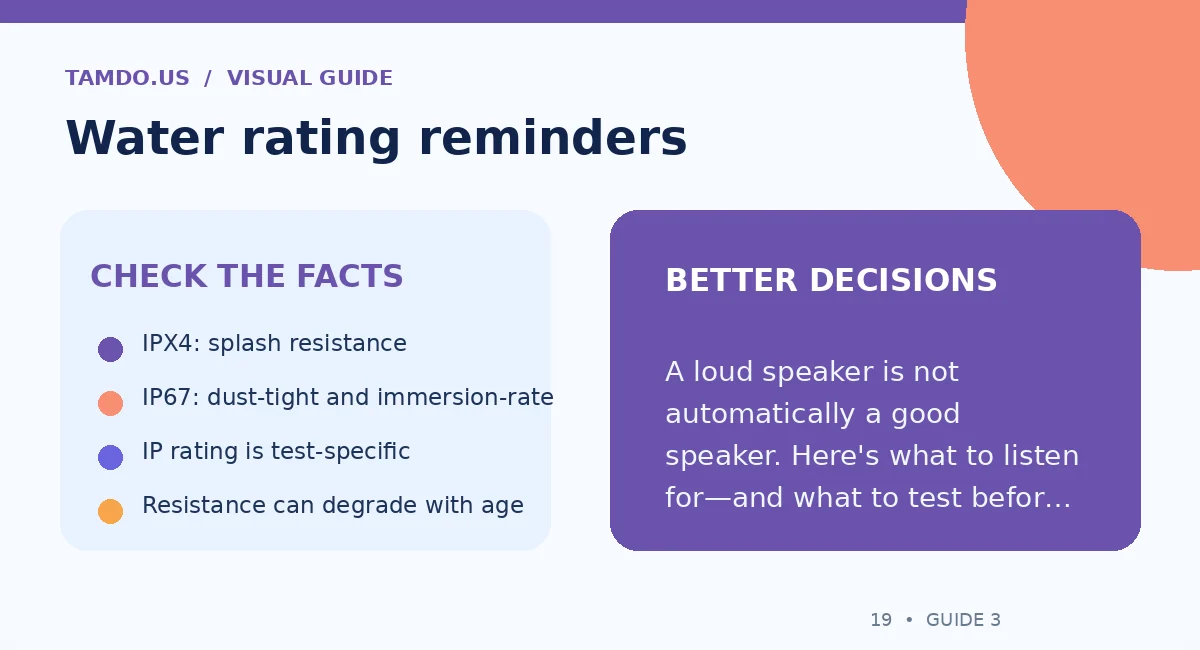
Water rating reminders — original educational illustration created for TamDo.us.
6. How to inspect a used Bluetooth speaker
Check the grille for dents and signs of heavy impact. Look for swollen seams, broken rubber coverings, corrosion, a loose charging connector, and missing port covers. Pair your own phone, play music at low and moderate volume, test buttons, and leave the unit running long enough to notice unexpected shutdowns.
Ask about the product's exact model and included cable. Some older models rely on discontinued apps or proprietary chargers. For units with replaceable batteries, check whether genuine or reputable compatible parts are available and whether replacement is economical.
7. A simple decision for budget buyers
If your priority is spoken-word audio and casual background music, a good compact speaker may be enough. If you want outdoor bass and higher volume, a larger model with useful weather protection may be the right investment. For a shared desk or two-person listening, stereo placement can sometimes matter more than marketing claims about power.
Browse portable audio and headphones at TamDo.us, and compare the condition of the exact listing with the features you need. Keep in mind that inventory, color options, and accessories change with each item.
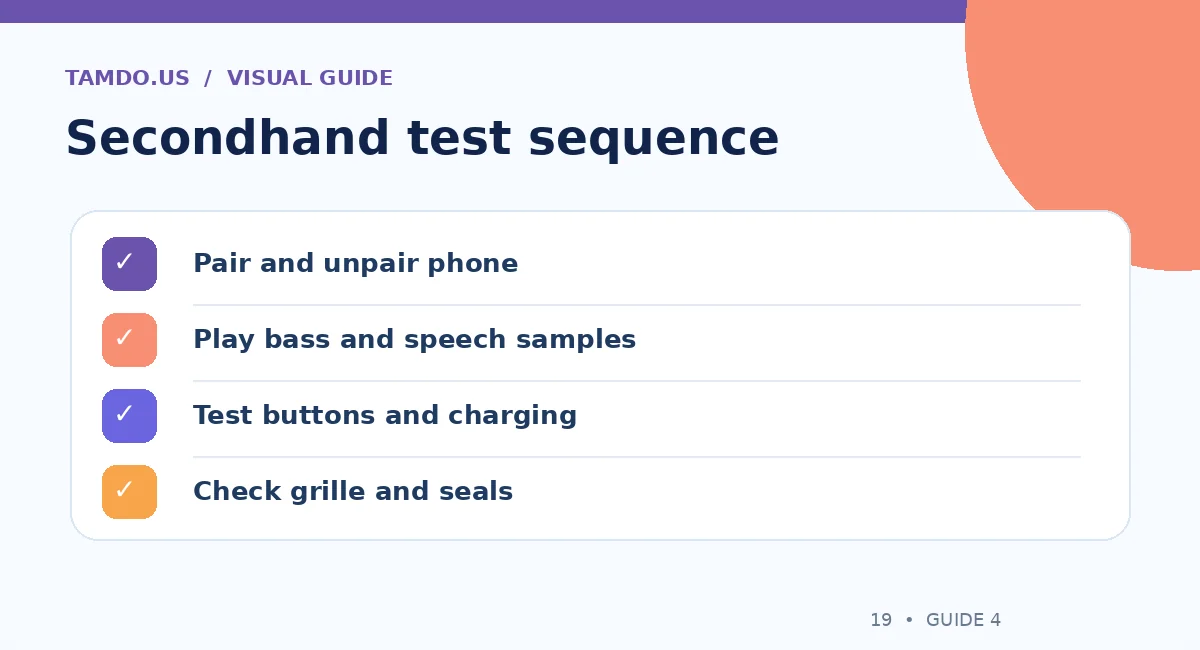
Secondhand test sequence — original educational illustration created for TamDo.us.
Final takeaway
Listen before judging, verify used-battery behavior, understand the limits of IP ratings, and test pairing and charging. The best Bluetooth speaker is the one that sounds right in your space and stays reliable after the first day.
Frequently Asked Questions
Does a higher wattage guarantee better sound?
No. Speaker design, tuning, room acoustics, and distortion matter as well.
Can I safely submerge any IP67 speaker?
Only within the manufacturer's specified conditions, and used devices may have worn seals.
Is Bluetooth 5 always better than Bluetooth 4 for music?
Not necessarily. Actual codec support, tuning, and connection quality are more useful measures.